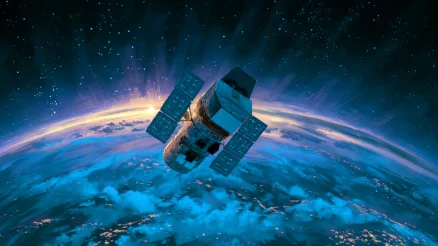
- Astronomers detected aurora activity on a starless rogue planet using JWST.
- SIMP-0136 has silicate sand clouds and surface temperatures above 1,500°C.
- JWST detected temperature changes smaller than 5°C from millions of miles away.
SIMP-0136 drifts through space twenty light-years from Earth. It orbits no star. It has no sun to warm it or light it up.
And yet, when a team at Trinity College Dublin pointed the James Webb Space Telescope at it, they found auroras dancing across the rogue planet's upper atmosphere.
The object is fifteen times the mass of Jupiter, technically a brown dwarf rather than a planet. Its surface temperature runs above 800°C. It rotates once every 2.4 hours.
The JWST data captured one full rotation, enough to build the first weather map of a world with no star to drive its weather.
(That is a genuinely strange sentence to be able to write. -Ed)
What Causes Auroras?
On Earth, auroras occur when charged particles from the Sun strike the upper atmosphere and excite gas molecules. The result is the coloured light displays near the poles. SIMP-0136 has no star to supply those particles. Its auroras appear to be powered by its own magnetic field interacting with charged material in surrounding space, producing a thermal inversion of roughly 250 degrees in the upper atmosphere.
Sand Clouds and a 2.4-Hour Day
The clouds on SIMP-0136 are not water. They are forsterite, a silicate mineral. Grains of sand, suspended in an atmosphere hot enough to keep them aloft.
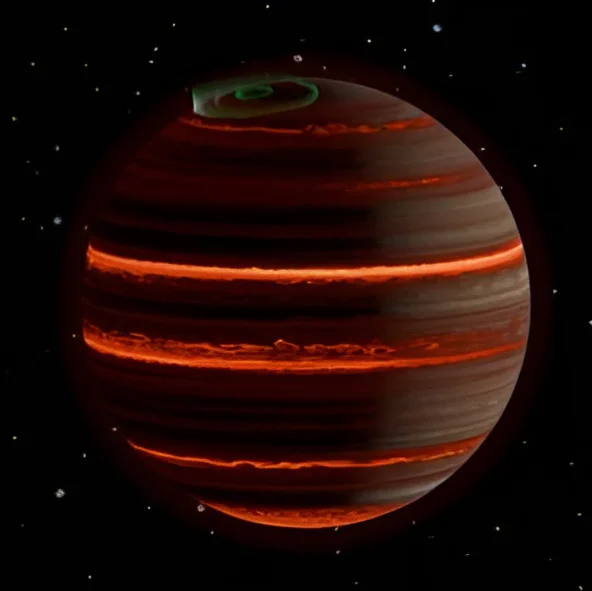
An artist's impression of auroras on SIMP-0136, a rogue planet. Image credit: Dr Evert Nasedkin, Trinity College Dublin
The JWST observations covered one full rotation, 2.4 hours from start to finish. As different hemispheres swung into view, the team tracked temperature shifts of roughly 5 degrees Celsius.
That precision, from twenty light-years away, is remarkable. It is the first time anyone has directly measured atmospheric changes on an object outside our solar system.
Key figure
5°C
Temperature precision achieved from twenty light-years away
The variability pattern was unexpected. On Jupiter, weather is driven largely by cloud bands and storm systems. On SIMP-0136, the temperature changes appear to come from magnetic and thermodynamic processes rather than cloud patchiness.
The silicate clouds are present, but they are not the main event. Something deeper is driving the weather.
These are some of the most precise measurements of the atmosphere of any extra-solar object to date, and the first time that changes in the atmospheric properties have been directly measured.
Dr Evert Nasedkin, Postdoctoral Fellow in Trinity College Dublin's School of Physics
What a Starless Rogue Planet Tells Us About the Rest
SIMP-0136 is useful precisely because it is alone. Brown dwarfs orbiting stars are drowned out by their host's light. A free-floating object twenty light-years away, with no stellar glare to subtract, is a clean target for scientific observations.
More On Planets

Why Identical Protoplanetary Discs Create Different Planets
Protoplanetary discs produce vastly different planets depending on UV exposure timing. One million years of shielding creates Earth instead of Moon-sized worlds.
→The techniques Nasedkin's team developed here, called rotational phase mapping across infrared wavelengths, are a prototype for studying atmospheres elsewhere.
The Extremely Large Telescope, which is expected to see first light in 2028, will have the resolution to apply these methods to objects orbiting stars. The goal is atmospheric characterisation of smaller, cooler worlds. And, potentially, habitable ones.
The auroras are the part of this story that will travel furthest. But the lasting contribution is quieter. It is a method for reading the weather on worlds we will never visit. Built on one complete rotation of a solitary object nobody expected to be this interesting.
At least SIMP-0136 has some light as it travels.

Fact Check: Claim-by-Claim Verification Verified
All claims accurately match the peer-reviewed paper and supporting sources from the Trinity College Dublin team.
Commentary
- Object called "rogue planet" popularly, though technically a planetary-mass brown dwarf; accurate for science journalism.
- Surface temperature ~1100-1500 K (~800-1200°C range), article's >800°C aligns with models.
- Previous radio data hinted at auroras; JWST provides first direct infrared evidence via thermal effects.
Sources used for verification
Academic/Peer-reviewed:
- The JWST Weather Report: retrieving temperature variations, auroral heating, and static cloud coverage on SIMP-0136 - arXiv
- A&A 702, A1 (2025) - The JWST Weather Report on SIMP-0136 - aanda.org
- Isolated Planetary-Mass Object SIMP 0136 (NIRSpec Light Curves) - science.nasa.gov
Other reliable sources:
Fact-checked by Perplexity Sonar Pro on 2026-03-11