Updated May 24, 2026
- Kordylewski's faint dust clouds sit at the Moon's stable L4 and L5 points.
- Their micron-sized grains span nine times Earth's width but stay nearly invisible.
- A 2018 polarized-light study confirmed the L5 cloud after 57 years of debate.
In 1961, Polish astronomer Kazimierz Kordylewski pointed his telescope at an empty patch of sky and saw two faint smudges that should not have been there. They sat near the stable gravitational points of the Earth-Moon system, looking like clouds.
He had spent years hunting for them. For the next half-century, almost nobody could find them again.
That is the strange thing about Earth's so-called ghost moons. They span an area nine times wider than our planet, yet they are so faint that careful observers using better equipment kept coming up empty. The 'Kordylewski dust clouds' carried his name and his reputation, and for decades it was an open question whether they existed at all.
The astronomy channel Astrum traced the full saga in a recent video (above), and the science behind it has only firmed up since.
Why Half a Century of Telescopes Found Nothing
The problem was never the size, it was the substance. The Kordylewski dust clouds, or KDCs, are made of particles roughly a micron across, similar in scale to a bacterial cell, spread thinly over a region about 100,000 kilometers by 70,000 kilometers. Plenty of width, almost no mass.
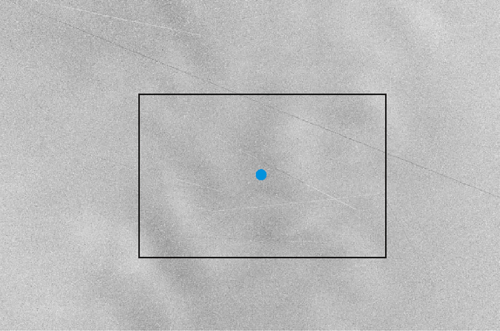
Polarimetric photograph of the L5 cloud on 12 August 2023. Darker shades of gray correspond to higher dust density. Credit: Slíz-Balogh et al. 2024 - https://doi.org/10.1093/mnras/stae1062 (CC BY 4.0)
So the detections came and went. In 1966, astronomers on four NASA flights aboard a high-altitude jet laboratory reported faint patches at both gravitational points, and the OSO-6 satellite recorded a signal the same year.
Then in 1976, Siegfried Röser at the Max Planck Institute for Astronomy ran numerical simulations and argued the points were too unstable to hold dust at all.
The skepticism had teeth. Radar surveys came back negative. In 1983, observers with a 61-centimeter telescope near Tucson searched both regions and saw nothing.
Yet the clouds kept reappearing. In 1989, the Polish astronomer Maciej Winiarski photographed them again and made the first three-color measurements, finding the dust looked redder than ordinary space dust, a hint the particles were chemically unusual.
Two years later, Japan's Hiten probe looped through the region and detected no particles, though its dust sensors may simply have been moving too fast to register such slow, sparse grains.
A Hungarian Team Used Polarized Light to Settle It
The breakthrough came in 2018, and it came from rethinking the instrument rather than building a bigger one. Judit Slíz-Balogh, an astronomer at Eötvös Loránd University in Budapest, working with the physicists Gábor Horváth and András Barta, decided the clouds had been invisible because telescopes were measuring the wrong property.
Their reasoning was elegant. Dust does not just reflect sunlight, it polarizes it, scattering the light at specific angles that depend on the size and arrangement of the grains. So the team built a sequential imaging polarimeter, taking a series of pictures through rotating filters to map how the faint light was polarized.
The patterns matched what their models predicted for sunlight bouncing off a dust cloud. In their 2018 paper in Monthly Notices of the Royal Astronomical Society, the team concluded the scattering particles "cannot be anything other than dust."
Key figure
9×
How much wider than Earth the L5 dust cloud spans, despite being nearly invisible
To check their own work, they simulated the motion of 1.86 million dust grains. Under the right conditions, the dust settled into the gravitational well at the L5 point and stayed, forming a cloud that mirrored the shape and size of the one their polarimeter had just photographed.
What are Lagrange points?
These are five positions in any two-body system, like the Earth and Moon, where gravity and orbital motion balance out, letting a small object hold its place. Three are unstable and need constant correction. Two of the five Lagrange points, called L4 and L5, are stable enough that dust and asteroids tend to gather there.
Why the Clouds Vanish and Return
The simulations explained the 57 years of contradiction. The L5 cloud is not a fixed object. Its density varies across its span and changes in rhythm with the Moon's orbit, more like a slow dust storm that forms, scatters, and reforms than a settled deposit.
Solar wind and the gravity of the Sun and planets keep nudging the delicate balance, dispersing the grains before they collect again. An observer in 1983 might have looked during a lull. An observer in 1966 might have caught a peak. Both were telling the truth.
There have been whispers among astronomers that something is out there, ghostly spectres lurking in our orbital path.
Alex McColgan, Astrum
This makes the ghost moons stranger than Earth's better-known temporary companions.
Minimoons and quasi-moons are solid objects that drift in and out within months or years. The Lagrange points that trap the KDCs have existed since the Earth-Moon system formed, which means the dust phenomenon, in some form, could be billions of years old.
The Hunt Has Moved to a Portable Telescope
Slíz-Balogh and Horváth did not stop in 2018. In the summer of 2023, the team carried a single-camera polarimetric telescope to the Isabis Astro Lodge in Namibia's Khomas Highland and observed the L5 cloud every clear night for four weeks.
Their results, published in Monthly Notices of the Royal Astronomical Society in June 2024, again confirmed the cloud and described it as patchy, built from several clumps of agglomerated grains rather than a smooth haze.
What remains is the L4 cloud, historically observed far less than its twin, and the deeper question of whether either cloud ever fully disappears.
The Hungarian group has already published the first polarimetric evidence for L4. The next campaigns will test whether the dust is a permanent fixture of Earth's neighborhood or a recurring visitor that simply waited 57 years for the right kind of light.
Sources
- Primary source: Scientists Have Spotted Something Huge Following Our Planet (Astrum / Alex McColgan)
- Additional context:
- Celestial mechanics and polarization optics of the Kordylewski dust cloud at L5, Part II (Slíz-Balogh, Barta & Horváth, MNRAS 2018)
- Observation of the L5 Kordylewski dust cloud with a portable imaging polarimetric telescope in the Namibian Khomas Highland (MNRAS 2024)
- Earth's dust cloud satellites confirmed (Royal Astronomical Society)

Fact Check: Claim-by-Claim Verification Verified
The core claims, that the Kordylewski dust clouds were first reported in 1961 and confirmed at L5 by polarimetric imaging in 2018 and again in 2024, are well supported by peer-reviewed MNRAS papers. One historical detail (the 1966 NASA and OSO-6 observations) was softened from "photographed clouds" to "reported faint patches" to match the cautious tone of the primary literature.
Sources used for verification
- Polarization optics of the Kordylewski dust cloud at L5, Part II - academic.oup.com
- Observation of the L5 KDC with a portable polarimetric telescope - academic.oup.com
- Earth's dust cloud satellites confirmed - ras.ac.uk