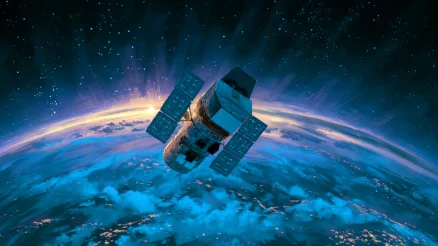
- Five equilibrium positions exist in every two-body orbital system | JWST orbits the Sun-Earth L2 point, 1.5 million km from Earth | L4 and L5 are stable; L1, L2, and L3 require station keeping | Jupiter's Trojan asteroids number over one million at L4 and L5
Lagrange points are five positions in a two-body orbital system where the gravitational pulls of both masses combine with orbital motion to let a smaller object hold station without drifting away.
Why It Matters
Key figure
5
Equilibrium positions in every two-body orbital system
Space agencies treat Lagrange points as fixed addresses in an otherwise featureless void. The Sun-Earth L2 point, 1.5 million kilometers behind Earth, hosts the James Webb Space Telescope, which began returning infrared images of the early universe in July 2022. Placing JWST there keeps Earth, the Sun, and the Moon all on one side of its sunshield, giving the telescope an uninterrupted view of deep space.
L1, the point between the Sun and Earth, serves a different purpose. NASA's SOHO spacecraft has observed the Sun from L1 since 1996, providing early warnings of solar storms headed toward Earth. The Deep Space Climate Observatory (DSCOVR) joined it in 2015, monitoring both solar wind and Earth's sunlit side.
The stable L4 and L5 points hold natural populations. Jupiter's L4 and L5 regions contain more than one million Trojan asteroids, trapped there by the combined gravity of Jupiter and the Sun. NASA's Lucy mission, launched in October 2021, is on a twelve-year tour to visit several of these Trojans for the first time.
How It Works
In any system where one large body orbits another (the Sun and Earth, or Earth and the Moon), five equilibrium positions emerge from the interaction of gravity and orbital mechanics. The three collinear points, L1, L2, and L3, sit along the line connecting the two large bodies.
L1 lies between them. L2 lies beyond the smaller body, on the side facing away from the larger one. L3 lies on the far side of the larger body, opposite the smaller one.
Key figure
1.5 million km
Distance from Earth to the Sun-Earth L2 point
L4 and L5 are different. Each forms the apex of an equilateral triangle with the two large masses at the other vertices. In 1772, the Italian-French mathematician Joseph-Louis Lagrange proved these triangular solutions exist as part of his work on the three-body problem. The three collinear points had been identified earlier, around 1750, by the Swiss mathematician Leonhard Euler.
L1, L2, and L3 are unstable. A spacecraft nudged even slightly from any of these points will drift away on a timescale of roughly 23 days. Maintaining position requires regular thruster firings, a practice called station keeping.
L4 and L5 are stable, but only when the mass ratio of the two large bodies exceeds about 24.96. The Sun-Earth and Sun-Jupiter systems both satisfy this condition, which is why natural objects accumulate there.
Key Context
In 2010, NASA's Wide-field Infrared Survey Explorer (WISE) confirmed 2010 TK7 as Earth's first known Trojan asteroid, orbiting near the Sun-Earth L4 point. The asteroid is roughly 300 meters across and librates around L4 in a complex path that keeps it at least 20 million kilometers from Earth.
The concept of placing structures at Lagrange points has a long speculative history. In 1974, the physicist Gerard K. O'Neill proposed building large space habitats at the Earth-Moon L5 point, an idea that inspired the founding of the L5 Society. That organization later merged with the National Space Society in 1987.
FAQ
Are Lagrange points truly stationary?
No. L1, L2, and L3 are positions of unstable equilibrium, meaning any small displacement grows over time. Spacecraft there perform regular station-keeping maneuvers, typically every few weeks. L4 and L5 are stable, but objects near them oscillate in tadpole or horseshoe-shaped orbits rather than sitting perfectly still.
How far is the Sun-Earth L2 point from Earth?
About 1.5 million kilometers, roughly four times the Earth-Moon distance. A spacecraft at L2 orbits the Sun at the same rate as Earth, staying permanently in Earth's shadow. JWST reached L2 approximately 30 days after its December 2021 launch.
What is the difference between Lagrange points and orbits?
An orbit is a continuous path around a body. A Lagrange point is a specific location where forces balance so that a small object can co-orbit with the two larger bodies. Spacecraft at unstable Lagrange points follow halo or Lissajous orbits around the point itself, not around either large body.
Could humans live at a Lagrange point?
In principle, yes. The Earth-Moon L4 and L5 points are gravitationally stable and relatively accessible. Gerard K. O'Neill proposed self-sustaining habitats there in the 1970s. No current mission targets crewed habitation at a Lagrange point, but several space agencies have studied the concept.
Related Reading


Sources
- Primary: What is a Lagrange Point? (NASA Science)
- Additional Context:
- What are Lagrange points? (European Space Agency)
- Lagrange Points: An Orbital Parking Spot for Satellites (NOAA NESDIS)
- Lagrange point (Encyclopaedia Britannica)

Fact Check: Claim-by-Claim Verification Verified
All 14 factual claims verified against NASA, ESA, Britannica, and Wikipedia sources. No inaccuracies found. Perplexity external check confirms all claims as Supported or Mostly supported.
Sources used for verification
- What is a Lagrange Point? - science.nasa.gov
- What are Lagrange points? - esa.int
- Lagrange Points: An Orbital Parking Spot - nesdis.noaa.gov
- Lagrange point - britannica.com
- Lagrange point - wikipedia.org