- Webb found pure molecular carbon in an exoplanet atmosphere no theory can explain.
- The planet orbits a pulsar at one million miles, completing a lap every 7.8 hours.
- Its carbon-to-oxygen ratio exceeds 100 — ruling out every known formation process.
The James Webb Space Telescope observed a lemon-shaped world with pure molecular carbon in its atmosphere. No known process can explain how it formed.
When the data from the James Webb Space Telescope arrived, Peter Gao of the Carnegie Earth and Planets Laboratory had the same reaction as everyone else on the team.
"What the heck is this?"
The exoplanet carbon atmosphere they were seeing should not exist. Every other world Webb has studied shows the expected signatures: water vapor, methane, carbon dioxide. PSR J2322-2650b showed none of these. Instead, the spectrum revealed molecular carbon in forms called C2 and C3, floating in a helium-dominated atmosphere.
No known planet formation mechanism produces this composition.
Key figure
>100
carbon-to-oxygen ratio – our Sun's is just 0.6
A Planet Stretched Into a Lemon
The object itself is as strange as its chemistry.
It orbits a millisecond pulsar, a neutron star the mass of the Sun but the size of a city. At just one million miles out, the planet completes a full orbit in 7.8 hours. Gravitational forces from the pulsar stretch it into a lemon shape.
What is a millisecond pulsar?
A pulsar is a neutron star – the collapsed core of a dead massive star – that emits beams of radio waves as it spins. Millisecond pulsars spin hundreds of times per second, far faster than ordinary pulsars, because they have been spun up by drawing in matter from a companion star. They are among the densest objects in the universe, packing the mass of the Sun into a sphere roughly the size of a city.
The planet orbits a star that's completely bizarre – the mass of the Sun, but the size of a city.
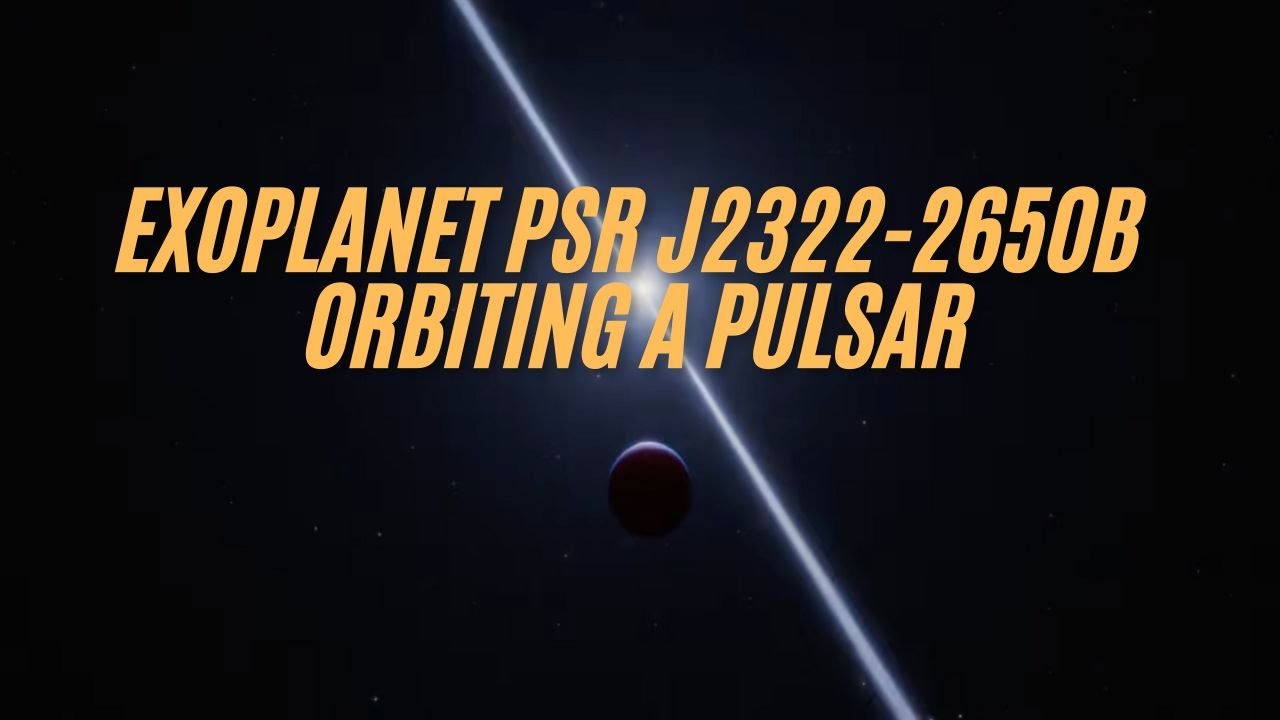
Model fits suggest the night side drops to around 900 Kelvin, while the day side reaches 2,300 Kelvin.
Intriguingly, the pulsar itself is invisible to Webb's infrared instruments. This quirk gave the team something rare: a pristine view of a planet without the overwhelming glare of its host star. Michael Zhang, the University of Chicago astronomer leading the study, called the system "unique" for this reason.
Carbon Ratios That Break the Models
The team detected C2 at 21-sigma confidence using cross-correlation spectroscopy. They also found C3, the molecule responsible for a sharp absorption cliff at 3.014 micrometers in the spectrum.
More tellingly, equilibrium chemistry calculations suggest the carbon-to-oxygen (C/O) ratio exceeds 100, and the carbon-to-nitrogen ratio exceeds 10,000. For comparison, our Sun has a carbon-to-oxygen ratio of about 0.6.
These numbers appear to rule out every proposed explanation the team considered. Standard black widow systems, where pulsars strip companion stars, produce helium-dominated remnants but not pure carbon. White dwarf mergers create carbon-rich objects, but their C/O ratios reach only 12 to 81. The triple-alpha process in carbon stars yields ratios of just a few. None comes close to 100.
Soot Clouds and Possible Diamonds
What the planet is made of, though, raises its own questions.
The atmosphere likely contains clouds of soot. Deeper down, under intense pressure, the carbon could crystallize into diamonds.
Did this thing form like a normal planet? No. Did it form by stripping the outside of a star? Probably not, because nuclear physics does not make pure carbon.
Michael Zhang, University of Chicago
Roger Romani, a Stanford physicist and one of the world's leading experts on black widow pulsar systems, proposed one hypothesis. As the companion cools, carbon and oxygen in the interior might separate. Pure carbon crystals could float upward into the helium atmosphere.
But something would need to keep oxygen and nitrogen away.
"That's where there's controversy," Romani admitted.
A Puzzle Worth Chasing
Of roughly 6,000 known exoplanets, this is the only one resembling a hot Jupiter while orbiting a pulsar. The team encourages observations of similar ultralight companions, particularly PSR J1719-1438, which has comparable mass but much higher density and may be an ultralow-mass carbon white dwarf.
Romani embraces the mystery rather than lamenting it.
"It's nice to not know everything," he said. "I'm looking forward to learning more about the weirdness of this atmosphere. It's great to have a puzzle to go after."
Sources
- Primary Research: Zhang, M. et al. (2025). "A Carbon-rich Atmosphere on a Windy Pulsar Planet." The Astrophysical Journal Letters, 995, L64. https://iopscience.iop.org/article/10.3847/2041-8213/ae157c
- Additional Context:

Fact Check: Claim-by-Claim Verification Verified
Limits and uncertainties
Core claims on atmosphere composition, shape, and orbit are clearly supported by JWST data and team analysis in the primary preprint. Diamond formation is model-based and plausible but not directly observed. Planet formation theories are challenged, with no consensus mechanism—readers should note this as speculative. All relies on accepted preprint and press releases; await final peer-reviewed ApJL for any refinements. Secondary journalism consistent but not independent verification.
Bottom line
JWST has confirmed a truly exotic exoplanet with unprecedented carbon-rich atmosphere around a pulsar. Claims hold up strongly to primary sources. Exciting puzzle for planet formation research.
Fact-checked by Perplexity Sonar Pro on 2025-12-18