- Yield stress fluids act as solids until force exceeds a threshold.
- Toothpaste, ketchup, and concrete all exhibit yield stress behavior.
- Eugene Bingham first described the concept in 1916 studying paints.
A yield stress fluid is a material that behaves as a solid when left undisturbed but flows like a liquid once an applied force exceeds a specific threshold called the yield stress.
Why It Matters
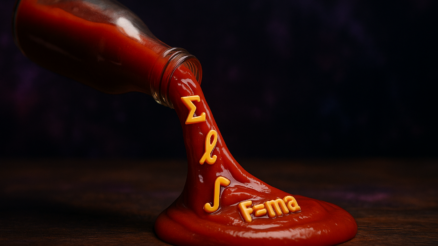
The boundary between solid and liquid is not always clean. Toothpaste holds its shape on a brush but glides smoothly when squeezed from the tube. Ketchup sits motionless in the bottle until a tap sends it rushing out.
Key figure
1916
Year Eugene Bingham first described yield stress behavior in paints
Fresh concrete fills a mold under vibration, then supports steel reinforcement once the shaking stops. Each material crosses the same invisible line: the yield stress.
That single threshold governs product design across food science, cosmetics, construction, and biomedical engineering. In 3D concrete printing, the material must flow through a nozzle under pressure but hold its shape the instant it exits. Getting the yield stress wrong by a few pascals means a collapsing structure or a clogged printer.
The concept also drives a technique called FRESH (Freeform Reversible Embedding of Suspended Hydrogels), developed by Adam Feinberg's group at Carnegie Mellon University. A needle extrudes soft bioinks inside a yield stress support bath that holds each printed filament in place. Their 2015 paper in Science Advances demonstrated printing of collagen-based structures, including coronary vasculature models.
How It Works
The physics begins at the microscopic level. Yield stress fluids contain suspended particles, polymers, or droplets that form weak internal networks through van der Waals forces, hydrogen bonds, or electrostatic interactions. These networks resist deformation and give the material solid-like behavior at rest.
Key figure
~100 Pa
Typical yield stress of toothpaste
When applied stress exceeds the yield stress, the network breaks apart. Particles rearrange, bonds snap, and the material flows. Remove the stress and the network rebuilds, a process rheologists call thixotropy.
The simplest mathematical description is the Bingham plastic model: stress equals yield stress plus viscosity times shear rate. Eugene Bingham, a chemist at Lafayette College in Pennsylvania, proposed it in a 1916 paper in the Bulletin of the Bureau of Standards based on experiments with paints.
The Herschel-Bulkley model, introduced by Winslow Herschel and Ronald Bulkley in 1926, adds a power-law exponent that captures shear thinning after yielding. Most real yield stress fluids follow Herschel-Bulkley more closely because their post-yield viscosity is rarely constant.
Measuring yield stress requires a rheometer, typically a cone-and-plate or parallel-plate geometry applying controlled stress or strain. The operator ramps stress upward and records the point where deformation becomes irreversible.
But measured values depend on the protocol: how fast stress increases, how long the sample rests beforehand, and even the geometry of the tool. This sensitivity has made measurement a persistent challenge in the field.
Key Context
Bingham formalized the concept in 1916, but the question of whether yield stress truly exists consumed rheologists for decades. In 1985, Howard Barnes and Ken Walters at Aberystwyth University argued that no true yield stress exists. Everything flows, they contended, given enough time, with an enormous but finite viscosity below the apparent threshold.
The dispute forced the field to refine its methods. By the 2000s, creep tests lasting hours confirmed that many soft materials exhibit viscosity bifurcation: a sharp, reproducible boundary between steady flow and continuously decelerating motion.
A comprehensive review by Daniel Bonn and colleagues in Reviews of Modern Physics (2017) concluded that yield stress is both measurable and physically meaningful within practical timescales, even if the philosophical question of truly zero flow remains open.
FAQ
Related Reading


Sources
- Primary Research: An Investigation of the Laws of Plastic Flow (Bingham, 1916)
- Additional Context:
- The yield stress myth? (Barnes & Walters, Rheologica Acta, 1985)
- Yield stress materials in soft condensed matter (Bonn et al., Reviews of Modern Physics, 2017)
- Three-dimensional printing of complex biological structures (Hinton et al., Science Advances, 2015)
- Printing by yield stress fluid shaping (Leal da Silva et al., Additive Manufacturing, 2023)

Fact Check: Claim-by-Claim Verification Verified
All 10 factual claims verified by both Claude and Perplexity sonar-pro-search. Numerical values for ketchup (15-25 Pa) and toothpaste (~100 Pa) yield stress are within published ranges, with appropriate qualifiers.
Sources used for verification
- Yield stress materials in soft condensed matter - aps.org
- An Investigation of the Laws of Plastic Flow - nist.gov
- The yield stress myth? - springer.com
- FRESH 3D bioprinting - science.org