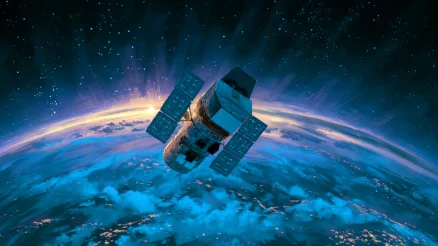
- A new metric shows catastrophic satellite collision could occur in just 2.8 days without tracking.
- The CRASH Clock shrank 97% since 2018 as megaconstellations crowded low-Earth orbit.
- A single collision triggers a slow cascade, not instant failure, but raises risk for all operators.
If every satellite suddenly lost its ability to dodge incoming debris, how long would it take before a catastrophic collision occurs? According to a new metric from researchers at Princeton University, the University of British Columbia, and the University of Regina, the answer is 2.8 days.
That's less time than a long weekend.
Key figure
2.8 days
time to catastrophic satellite collision if tracking systems fail
SpaceX loses one to two satellites per day due to their limited shelf life
As Victor Tangermann reports in Futurism, the team developed what they call the "Collision Realization and Significant Harm (CRASH) Clock" to quantify the mounting stress on Earth's orbital environment.
The metric measures how quickly a catastrophic crash would unfold if satellites lost their collision avoidance systems or situational awareness during a severe disruption like a powerful solar storm.
The Megaconstellation Problem
The urgency becomes clear when you look at the numbers. Back in 2018, before the megaconstellation era truly took off, the CRASH Clock stood at 121 days - roughly four months. Seven years later, that buffer has shrunk by more than 97 percent.
The reason? The explosive growth of satellite networks orbiting Earth. Between 2019 and 2025, the number of objects in low-Earth orbit nearly doubled from 13,700 to over 24,000. SpaceX alone operates around 9,000 functioning Starlink satellites, representing more than 60 percent of all active satellites currently circling the planet.
These aren't theoretical risks. During a strong solar storm in May 2024, countless satellites had to adjust their orbits. The chaotic movements made "collision avoidance maneuvers extremely uncertain," the researchers note in their yet-to-be-peer-reviewed paper.
Kessler Syndrome Isn't Hollywood
The term "Kessler syndrome" comes from a 1978 NASA paper by researcher Donald Kessler, who warned that a single satellite collision could trigger a cascade of follow-up accidents. Each crash would increase the probability of further collisions, eventually creating a debris belt that could make Earth's orbit unusable.
What is Kessler syndrome?
Kessler syndrome is a scenario where the density of objects in low-Earth orbit becomes so high that collisions produce debris, which causes more collisions in a self-sustaining chain reaction. Named after NASA scientist Donald Kessler, who first described it in 1978, it describes a tipping point after which parts of Earth's orbit could become permanently unusable.
But the researchers are careful to explain that catastrophic doesn't mean instant apocalypse.
"A major collision is more akin to the Exxon Valdez oil spill disaster than a Hollywood-style immediate end of operations in orbit," they write. Satellite operations could continue after a major collision, but with different parameters–including a significantly higher risk of collision damage.
The trainwreck would unfold in slow motion over decades or even centuries. What makes this significant is that even a single collision creates substantial stress on the orbital environment immediately, forcing all operators to navigate a more dangerous space.
More Satellites, More Risk
The situation will only intensify. SpaceX loses one to two satellites per day due to their limited shelf life, and just today the company admitted it had lost contact with a tumbling Starlink satellite following a mishap.
While SpaceX assured that the satellite poses no risk to the International Space Station and will burn up within weeks, the incident highlights how quickly things can go wrong.
And SpaceX isn't alone. Amazon and China Aerospace Science and Industry Corporation are racing to launch their own broadband constellations, meaning the number of objects overhead will rise exponentially in coming years.
Beyond collision risks, experts worry about other consequences. The satellites disrupt astronomical observations, and burning satellites may release aluminum oxides that damage the upper atmosphere and ozone layer. The researchers emphasize the urgent need for better ways to quantify orbital stress and improved oversight.
The CRASH Clock gives us a number to watch. Right now, that number is alarmingly small.

Fact Check: Claim-by-Claim Verification Verified
The recap accurately represents the arXiv preprint's claims, including the CRASH Clock metric, timelines, institutions, and solar storm context, with appropriate simplifications for popular science.
Commentary
- LEO object count (~24,000) and Starlink functioning satellites (article's ~9,000 vs. sources' 4,800-7,600) show minor variance due to rapidly changing catalogs post-June 2025, but does not alter core claims.
- SpaceX daily satellite loss rate (1-2 per day due to shelf life) is generalized but consistent with ongoing deorbiting mentioned in paper and reports.
- Kessler syndrome origin (1978 NASA paper by Donald Kessler) is standard and accurately attributed.
Sources used for verification
Academic/Peer-reviewed:
Other reliable sources:
- 2.8 days to disaster: Why we are running out of time in low earth orbit - phys.org
- Paper proposes a CRASH Clock for satellite collision risk - theregister.com
- A Single Solar Storm Could Trigger an End to Space Travel. Here's How. - sciencealert.com
- How many satellites orbit Earth? - livescience.com
Fact-checked by Perplexity Sonar Pro on 2025-12-21