


- A Japanese team mapped consistent neural patterns for color perception across 35 people.
- The study used fMRI similarity judgments instead of verbal descriptions.
- Neuroscientist Anil Seth proposes qualia emerge from predictive brain processes.
Takahiro Hirao asked 35 volunteers a question philosophers said was unanswerable: what is qualia, and can it be measured?
The answer required lying still inside an fMRI scanner while comparing nine different colors.
What is qualia?
Qualia are the subjective qualities of conscious experience: the redness of red, the sharpness of pain, the taste of coffee. Philosophers have long debated whether these private experiences can be studied scientifically or lie permanently beyond measurement.
What Is Qualia? A Problem Called Unsolvable
Thomas Nagel laid the philosophical groundwork in 1974. In his essay "What Is It Like to Be a Bat?" the New York University philosopher argued that subjective experience is fundamentally inaccessible to outside observers. Even complete knowledge of a bat's brain would not reveal what echolocation feels like from the inside.
David Chalmers pushed the idea further with what he named the "hard problem of consciousness." Physical descriptions of brain activity, he argued, cannot explain why experience feels the way it does.
For decades, most scientists accepted the boundary: qualia belonged to philosophy.
A Japanese Lab Found Patterns Where None Should Exist
Hirao and his colleagues at Japan's National Institutes for Quantum Science and Technology took a different approach. Rather than asking participants to describe their color experiences in words, the team designed a "qualia structure" paradigm based on relational similarity judgments between color pairs.
Participants judged how similar their experiences of two colors felt. The team recorded brain activity during these judgments, including a "no-report" condition where participants simply perceived without being asked to respond.
Each of the 35 volunteers completed all thirty-six possible color pairings across four scanning sessions.
Key figure
35
Participants in the first fMRI study to map the relational structure of color qualia
The results, published in Scientific Data in March 2025, showed consistent neural patterns across participants for the same colors. Brain regions V4 and V8 in the ventral occipitotemporal cortex displayed structural similarities that correlated with shared color perception.
Your red, it appears, is structurally similar to mine.
The finding does not prove identical inner experiences. Neural architecture may be shared while the subjective quality still differs.
But the study establishes something the philosophical tradition said was impossible: qualia have a measurable relational structure, one that can be compared across brains.
More about consciousness research
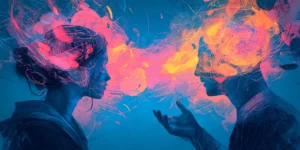
Why We Can Never Prove That Someone Else is Conscious
'Rival' scientists use category theory to show that while 'shapes' of experiences might be matched across minds, we can never observe the feeling itself.
→From Philosophy to Prediction Algorithms
Anil Seth, a neuroscientist at the University of Sussex, has proposed a framework that could explain why these patterns exist. In his predictive processing model, the brain constantly generates expectations about incoming sensory data and corrects itself when those expectations miss.
Qualia, in this account, are not mysterious extras. They are functional elements the brain uses to organize perception.
Color, body orientation, temperature: each serves as a reliable anchor in the brain's prediction-correction cycle.
Seth argued in his 2021 book "Being You" that the right question is not why consciousness exists, but why specific brain patterns map to specific kinds of experience.
We argue that there is no good reason to think that colors are less objective than, say, temperature.
Philosophers, The Metaphysics of Color
The Qualia Research Institute in San Francisco is attempting something more ambitious still. The nonprofit, founded in 2018, aims to build a mathematical formalization of subjective experience and map what it calls the "state space of consciousness."
More On Color Physics

Two Major Theories of Consciousness Unable To Explain Awareness
Neither dominant explanation survived the most rigorous test in the field's history. That may be exactly what neuroscience needed.
→QRI is moving from theory into practical applications, with validated models and technologies aimed at reducing suffering. The institute is fundraising $1.5 million for its 2026 research program.
Even some philosophers are shifting their position. A recent book called The Metaphysics of Color makes the case that color is as real and objective as temperature.
The philosophical walls around qualia are thinning. Whether they fall entirely depends on whether the structural patterns Hirao's team found extend beyond color to pain, emotion, and other domains of experience.
That question is no longer purely philosophical.
Sources
- Primary Source: A neuroimaging dataset during sequential color qualia similarity judgments (Scientific Data, Nature)
- Additional Context:
- Anil Seth's published research (University of Sussex)
- Scientists Measure Qualia for First Time (Sabine Hossenfelder)

Fact Check: Claim-by-Claim Verification Verified
The article accurately reports the Hirao et al. study's details and methods while appropriately hedging philosophical claims about qualia.
Commentary
- The article implies the study "showed consistent neural patterns across participants," but the dataset paper focuses on behavioral consistency; neural analysis awaits future publications.
- Claim that qualia are "measurable" reflects the study's paradigm but remains interpretive given philosophical debates.
- Pullquote from "The Metaphysics of Color" matches the book's argument that colors are objective like temperature.
Sources used for verification
Academic/Peer-reviewed:
- A neuroimaging dataset during sequential color qualia similarity judgments - Nature
- A neuroimaging dataset during sequential color qualia similarity judgments with and without reports - PMC
Other reliable sources:
- 私たちの研究成果論文がYouTubeチャンネルで紹介 - qualia-structure.jp
- QRI Research Revealed: From Theory to Consciousness Engineering (2026 Fundraiser) - qualiacomputing.com
Fact-checked by Perplexity Sonar Pro on 2026-03-11


