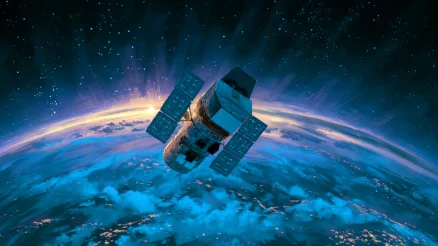
- Solar wind is a constant plasma stream from the Sun at 400-800 km/s
- It compresses Earth's magnetosphere and drives geomagnetic storms
- The 1989 Quebec blackout showed infrastructure vulnerability
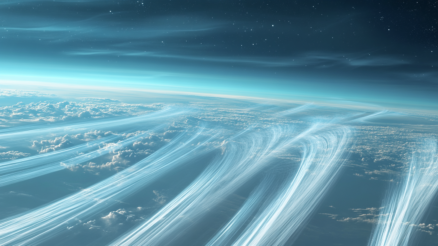
Solar wind is a continuous stream of charged particles, mostly protons and electrons, flowing outward from the Sun at 400 to 800 kilometers per second. When this plasma reaches Earth, it compresses the planet's magnetic field, drives geomagnetic storms, generates auroras, and can disrupt power grids, satellites, and communications.
Why It Matters
Key figure
1.6 million km/h
Top solar wind speed
Every second, roughly one million tons of plasma escape the solar corona and race outward through the solar system. Astrophysicist Eugene Parker at the University of Chicago predicted this outflow in 1958, calculating that the corona's extreme temperature (over one million degrees Celsius) would overcome the Sun's gravity and push charged particles into interplanetary space.
The scientific community was skeptical. A year later, the Soviet spacecraft Luna 1 detected the stream directly. By 1962, NASA's Mariner 2 had confirmed two distinct components: a slow wind near 400 km/s and a fast wind exceeding 700 km/s from coronal holes.
Earth sits inside this flow. The planet's magnetosphere deflects most of the incoming plasma, but the interaction is not passive. Solar wind compresses the magnetic field on the dayside and stretches it into a long tail on the nightside.
During periods of intense solar activity, coronal mass ejections (massive eruptions of magnetized plasma) can reach Earth in as little as 15 to 18 hours. These trigger geomagnetic storms that ripple through the magnetosphere, producing consequences both beautiful and destructive.
Charged particles spiral along magnetic field lines toward the poles, colliding with atmospheric gases to create the aurora borealis and aurora australis. The same storms can induce electric currents in long conductors on the ground, including power lines and pipelines. In March 1989, a severe geomagnetic storm caused by a coronal mass ejection collapsed Quebec's power grid in 92 seconds, leaving six million people without electricity for nine hours.
How It Works
The solar wind originates in the corona, the Sun's outermost atmospheric layer. Coronal holes (regions of open magnetic field lines) release fast solar wind at 500 to 800 km/s. The slower component, near 400 km/s, emerges from regions where magnetic field lines are more tangled and partially closed.
As the plasma travels outward, the Sun's rotation twists the embedded magnetic field into a spiral pattern known as the Parker spiral. By the time the wind reaches Earth (roughly 150 million kilometers away), the magnetic field direction within it determines how strongly it will interact with our magnetosphere.
A southward-pointing interplanetary magnetic field is the key ingredient for severe geomagnetic storms. It opposes Earth's northward-pointing field and allows solar plasma to breach the magnetosphere through a process called magnetic reconnection.
Key figure
$220 billion
Minimum US damage estimate from extreme storm
The effects cascade through technology. Geomagnetically induced currents can saturate transformer cores in high-voltage power grids, causing overheating and permanent damage. GPS accuracy degrades as ionospheric disturbances alter signal propagation times. Satellite electronics face increased radiation exposure, and low-orbit spacecraft experience greater atmospheric drag as the upper atmosphere heats and expands.
A 2017 study by the Cambridge Centre for Risk Studies estimated that an extreme geomagnetic event could cost the US economy between $220 billion and $1.2 trillion.
Key Context
The Carrington Event of September 1859 remains the strongest recorded geomagnetic storm. Telegraph operators reported electric shocks, and some telegraph systems continued operating even after being disconnected from their batteries, powered solely by geomagnetically induced currents. A comparable event today would pose severe risks to interconnected power infrastructure, particularly in the eastern and midwestern United States, where resistive bedrock amplifies induced ground currents, according to the U.S. Geological Survey.
NASA's Parker Solar Probe, launched in 2018 and named after Eugene Parker himself, completed its 27th close approach to the Sun in March 2026 at a distance of approximately 6.1 million kilometers. The mission has revealed new details about how the solar wind accelerates and how magnetic structures called switchbacks form near the Sun's surface.
FAQ
What is the difference between solar wind and a coronal mass ejection?
Solar wind is a constant, steady outflow of plasma from the Sun. A coronal mass ejection is a sudden, massive eruption of magnetized plasma that travels through the solar wind. CMEs can carry billions of tons of material and, when directed at Earth, cause far more intense geomagnetic storms than the background solar wind alone.
Can solar wind reach Earth's surface?
No. Earth's magnetosphere and atmosphere block the charged particles. The solar wind's effects are felt indirectly through magnetic field disturbances, induced electric currents, and interactions with the upper atmosphere. At ground level, the primary risk comes from geomagnetically induced currents in long conductors like power lines.
How much warning do we get before a solar storm hits Earth?
Satellites at the L1 Lagrange point, about 1.5 million kilometers from Earth, detect incoming solar wind and coronal mass ejections roughly 15 to 60 minutes before they arrive. Solar observatories can spot CMEs leaving the Sun one to three days earlier, but predicting their magnetic field orientation (the factor that determines storm severity) remains difficult.
Does solar wind affect Earth's atmosphere over long timescales?
Yes. Solar wind contributes to atmospheric erosion by stripping ions from the upper atmosphere, a process called sputtering. Mars, which lacks a global magnetic field, has lost most of its original atmosphere partly through this mechanism. Earth's magnetosphere limits this loss, but during geomagnetic reversals, the weakened field may have allowed greater atmospheric escape.
Related Reading


Sources
- Primary: What Is the Solar Wind? (NASA Science)
- Primary: Solar Wind (NOAA Space Weather Prediction Center)
- Additional Context:
- What is the solar wind? (University of Chicago News)
- What a Solar Superstorm Could Mean for the US (USGS)
- The dangers of geomagnetic storms (Allianz / Cambridge Centre for Risk Studies)
- Parker Solar Probe Makes 27th Swing Around the Sun (NASA, March 2026)

Fact Check: Claim-by-Claim Verification Verified
All major claims verified across both Claude and Perplexity checks. Solar wind speeds, Parker's 1958 prediction, Luna 1 detection, Quebec 1989 blackout details, Carrington Event, Parker Solar Probe 27th flyby, and Cambridge Centre economic estimates all confirmed by authoritative sources.
Sources used for verification
- What Is the Solar Wind? - NASA Science
- Solar Wind - NOAA SWPC
- What is the solar wind? - University of Chicago
- What a Solar Superstorm Could Mean for the US - USGS
- Parker Solar Probe 27th Flyby - NASA